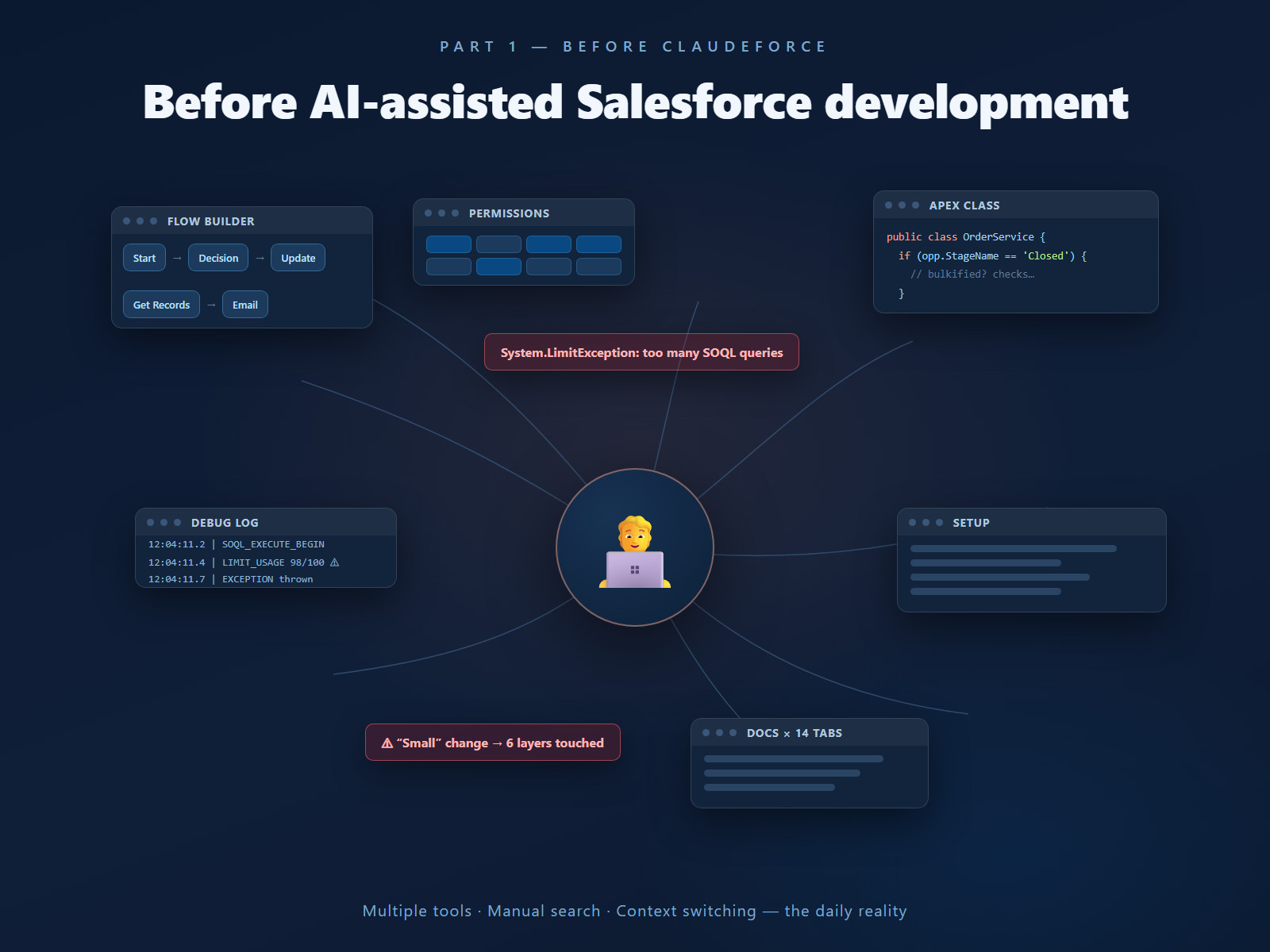
A manager walks over with what sounds like a simple request: “Can you just add one small automation?” Before writing a single line of code, they open the org’s existing Flows to see what already automates the process, scan Apex classes and triggers that might conflict, check permission sets, review integration limits, and trace how the object feeds three dashboards and a nightly data sync. The “small” request quietly touches six layers of a system that took a decade to grow.
That gap — between a plain-English business request and the technical reality of a mature Salesforce org — is exactly the space Claudeforce was created to shrink.
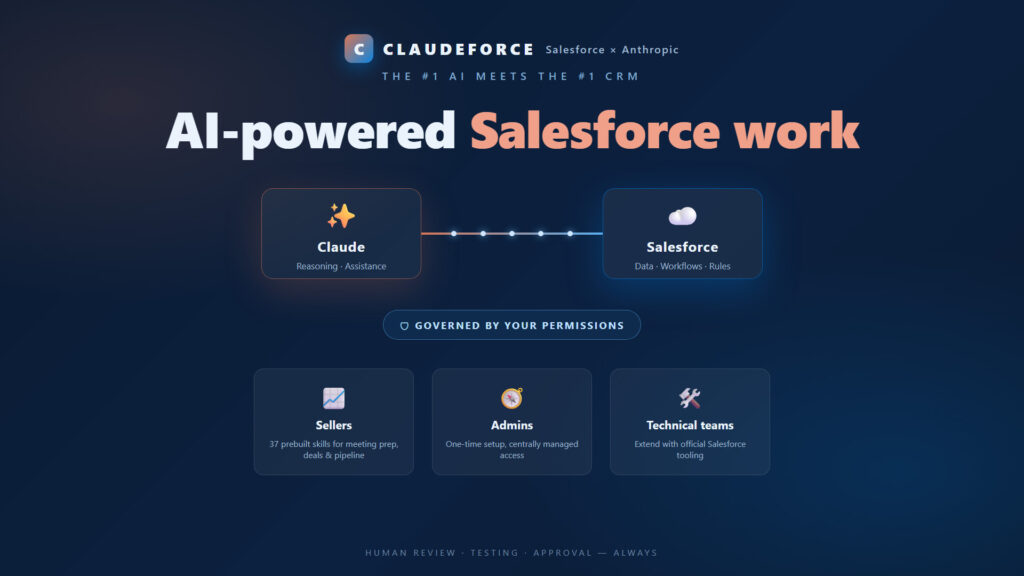
Claudeforce is an expanded strategic partnership between Salesforce and Anthropic, announced on August 26, 2026. It brings Anthropic’s Claude together with Salesforce’s data, workflows, business logic, actions, and governance, so people can work with their CRM through natural language instead of clicking through screens. In Salesforce’s own words, it puts “your trusted data to work inside Claude — governed by the permissions and business rules your company already runs on.”
Claudeforce in 60 Seconds
Claudeforce is the Salesforce–Anthropic partnership that puts your trusted Salesforce data and workflows to work inside Claude — governed by the permissions and business rules your company already runs on. The first product, Salesforce in Claude, ships 37 prebuilt skills for sales teams, with an open beta expected in September 2026. Admins set it up once and manage access centrally. Developers extend it through official Salesforce tooling built for Claude Code. Humans review; Salesforce’s governance stays in control.
Before Claudeforce: What Salesforce Work Actually Looked Like
To understand why Claudeforce exists, you have to understand what working in Salesforce has meant for the last twenty-five years — because the platform’s strengths created its own kind of complexity.
Salesforce is not one tool. It’s a platform you assemble. Companies build on it with:
- Apex — Salesforce’s Java-like programming language for custom logic: “when an opportunity reaches this stage, do these five things.”
- Lightning Web Components (LWC) — the framework for building custom user interfaces that run inside Salesforce pages.
- Flow — the point-and-click automation builder admins use to wire up approvals, updates, and alerts without code.
- Metadata — the behind-the-scenes definition of everything in your org: every field, layout, rule, and automation. It’s what makes Salesforce customizable — and what makes orgs hard to read.
- Tests and deployments — Apex requires test coverage before code can deploy, and changes move between sandbox and production through careful release steps.
None of this is a flaw. It’s why Salesforce can model a bank, a hospital network, and a manufacturer on the same platform. But it produces a real working condition: the knowledge is spread across many layers and many tools. A developer keeps a code editor, Setup, Flow Builder, debug logs, and documentation open at once. An administrator inherits orgs built by people who left years ago and reverse-engineers them one Flow at a time. A business user waits in a ticket queue because every “small” change needs investigation first.
Traditional Salesforce development rewards careful, manual craft: strong release processes, thoughtful testing, disciplined documentation. What it has never offered is a way to simply ask the org a question and get a trustworthy, governed answer.
Which leads to the question this whole industry has been circling:
What if the distance between a business requirement and a working Salesforce solution could become much smaller?
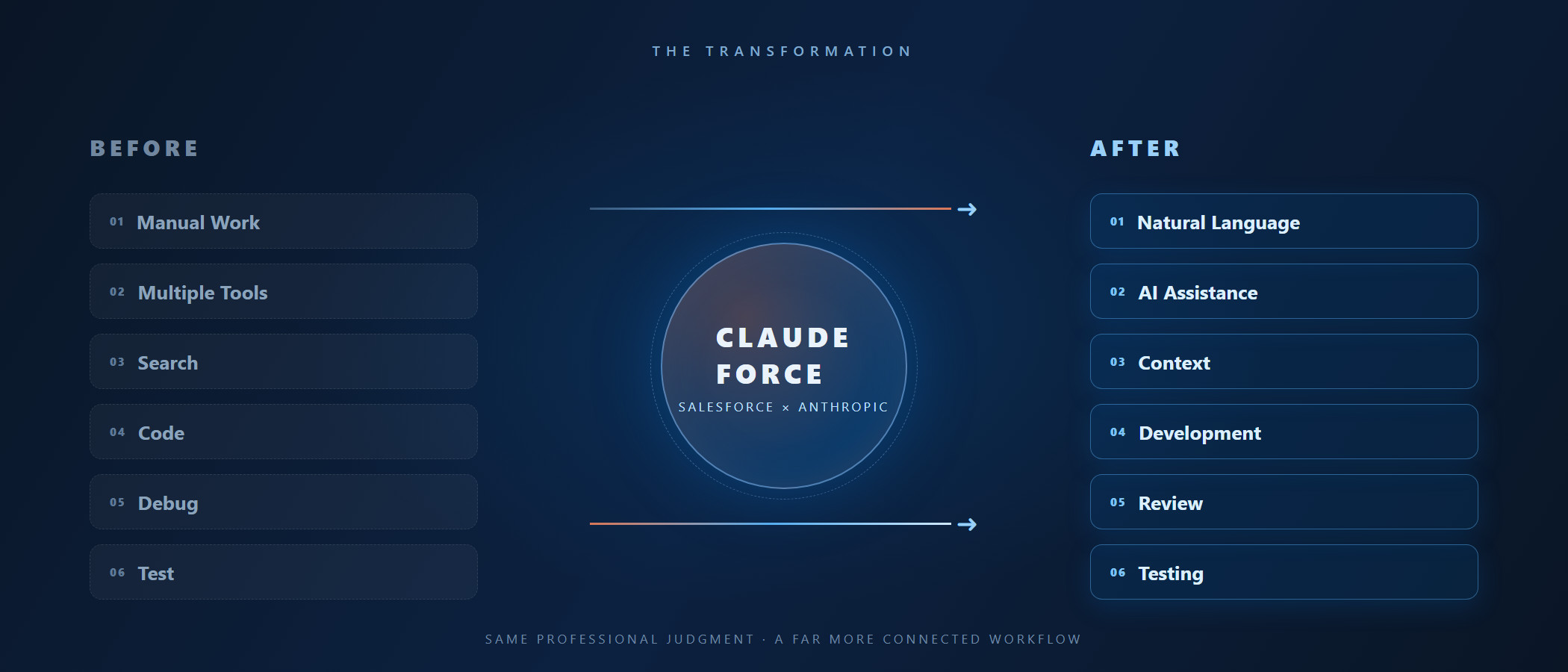
Why Claudeforce? The Story Behind the Partnership
Why was Claudeforce created? Because two companies each held half of the same puzzle.
Anthropic’s half is Claude — one of today’s leading frontier AI models — plus Claude Code, Anthropic’s agentic coding tool that reads a codebase, edits files, runs commands, and connects to external systems, and the Model Context Protocol (MCP), the open standard Anthropic introduced in November 2024 that lets AI assistants connect securely to data sources and tools. MCP is best understood as “USB-C for AI integrations”: one standard plug instead of a custom cable for every system.
Salesforce’s half is the platform where a company’s customer truth lives: its data, workflows, business logic, and — critically — its governance: permissions, sharing rules, validation, and audit. Salesforce had also been rebuilding itself around agents with Agentforce, where Claude already serves as a reasoning engine model inside the Salesforce Trust Boundary.
Claudeforce is the productized union of the two. The partnership began in earnest in October 2025, when Anthropic and Salesforce announced Claude as a preferred model for Agentforce and the first LLM fully integrated within the Salesforce Trust Boundary. In August 2026, they expanded it into Claudeforce with a first product, Salesforce in Claude: a Claude plugin whose 37 co-engineered skills let sellers do meeting prep, deal-health reviews, and pipeline reviews directly in Claude — with Salesforce’s rules enforced underneath every action.
Think of it this way: Claudeforce is not a new Salesforce, and it is not a chatbot bolted onto one. It is an AI-powered development partner sitting beside a Salesforce professional — able to understand requests, investigate problems, explain existing systems, and draft work — while Salesforce itself remains the system of record and the enforcer of the rules.
And the division of responsibility is worth stating plainly: humans remain responsible for reviewing, validating, testing, securing, and approving every change. Claudeforce accelerates the path to a proposal. People still make the decisions.
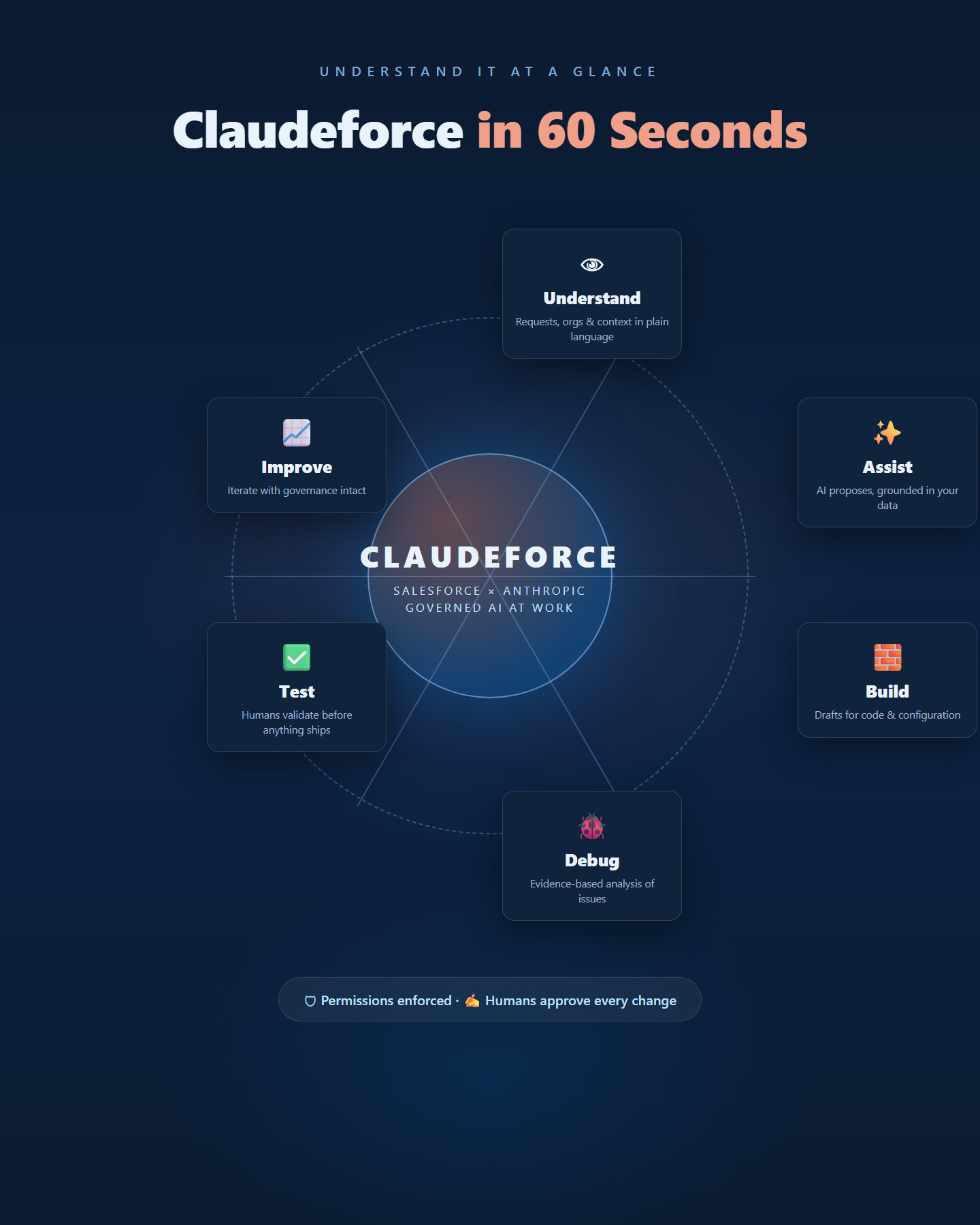
How Does Claudeforce Work?
Claudeforce works by connecting Claude to Salesforce through Salesforce’s own governed infrastructure — not by copying your data into a chatbot.
- Business requirement. It starts in plain language: “Prep me for the Meridian call,” or “Which deals moved backwards this week?”
- Natural-language request. The person asks in Claude — no menus, no object names required.
- Claudeforce connection. Salesforce in Claude runs over a secure MCP connection into Salesforce’s Headless 360 architecture, the layer that exposes CRM data and workflows to agents without custom integrations.
- Context and analysis. Claude reasons over live Salesforce context — pipeline, records, activity — the way a skilled analyst would, except it reads the whole picture in seconds.
- Suggested solution. Claude proposes: a summary, a plan, a draft, a recommended action — with its reasoning visible.
- Governed execution. This is the part that matters. Actions route through Salesforce, so business rules are enforced when anything actually happens. Claude only sees and does what the authorized user is allowed to see and do.
- Human review. Every consequential step stays with a person — approve, edit, or reject.
- Deployment / done. Work lands inside Salesforce’s normal governance, audit, and backup story — including Salesforce Shield and sandboxes.
Setup is designed to be one-time admin work: centrally managed authentication and permissions, with no per-user configuration. On the security roadmap, Salesforce and Anthropic have announced Enterprise Frontier Safeguards — zero data retention, customer-controlled encryption keys, and audit logging — rolling out in phases beginning later in fall 2026.
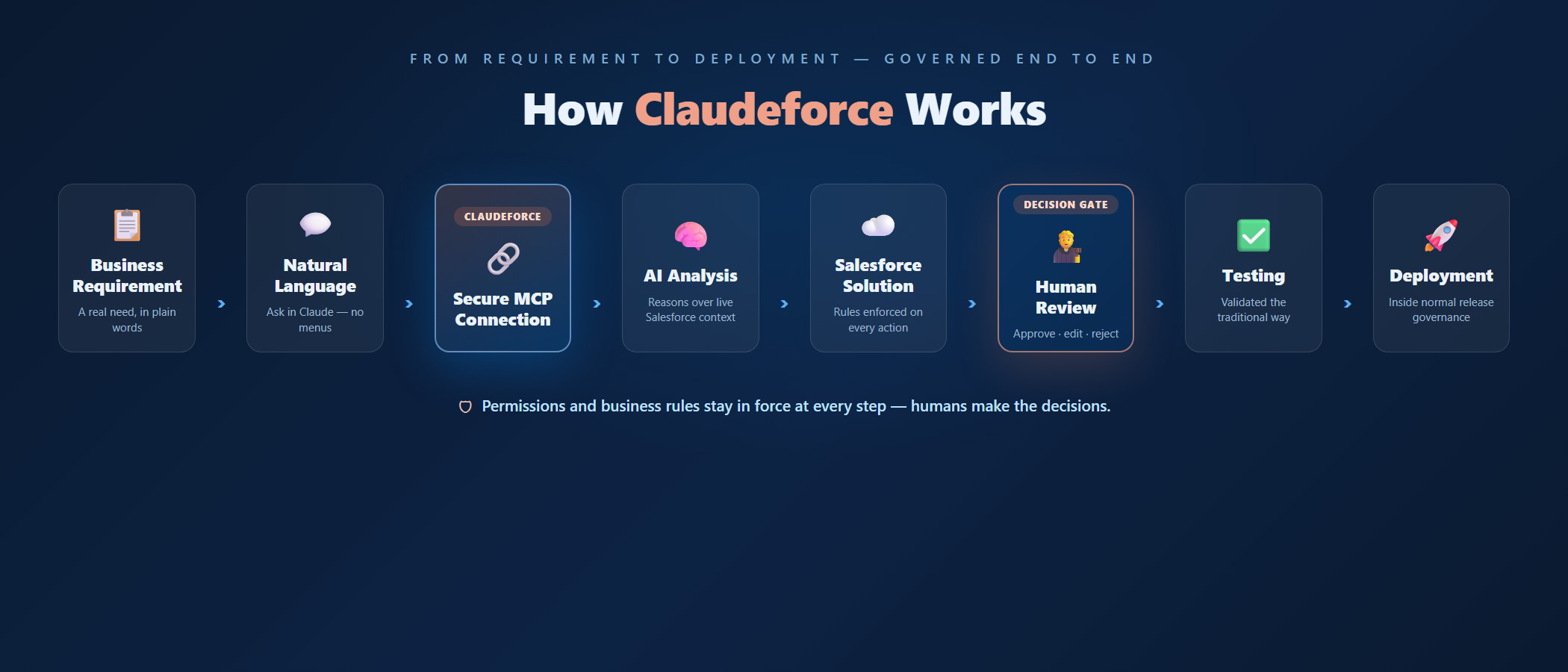
Before vs. After: What Actually Changes?
| Before Claudeforce | With Claudeforce |
|---|---|
| Requirement → multiple manual steps across tools | Requirement → AI-assisted workflow |
| Search documentation and org config by hand | AI-assisted understanding of existing setup |
| Repetitive build work (drafts, boilerplate, queries) | AI-assisted development, human-reviewed |
| Manual troubleshooting across logs and metadata | AI-assisted analysis of the same evidence |
| Many disconnected steps and screens | A more connected, conversational workflow |
| High repetitive effort per “small” request | Reduced repetitive effort — decisions stay human |
Notice what the right-hand column does not say. It doesn’t say “automatic” or “hands-off.” Every improvement is assisted, and every consequential step keeps a human in the loop — because that is literally how the offering is engineered: actions route through Salesforce’s governance, and people approve.
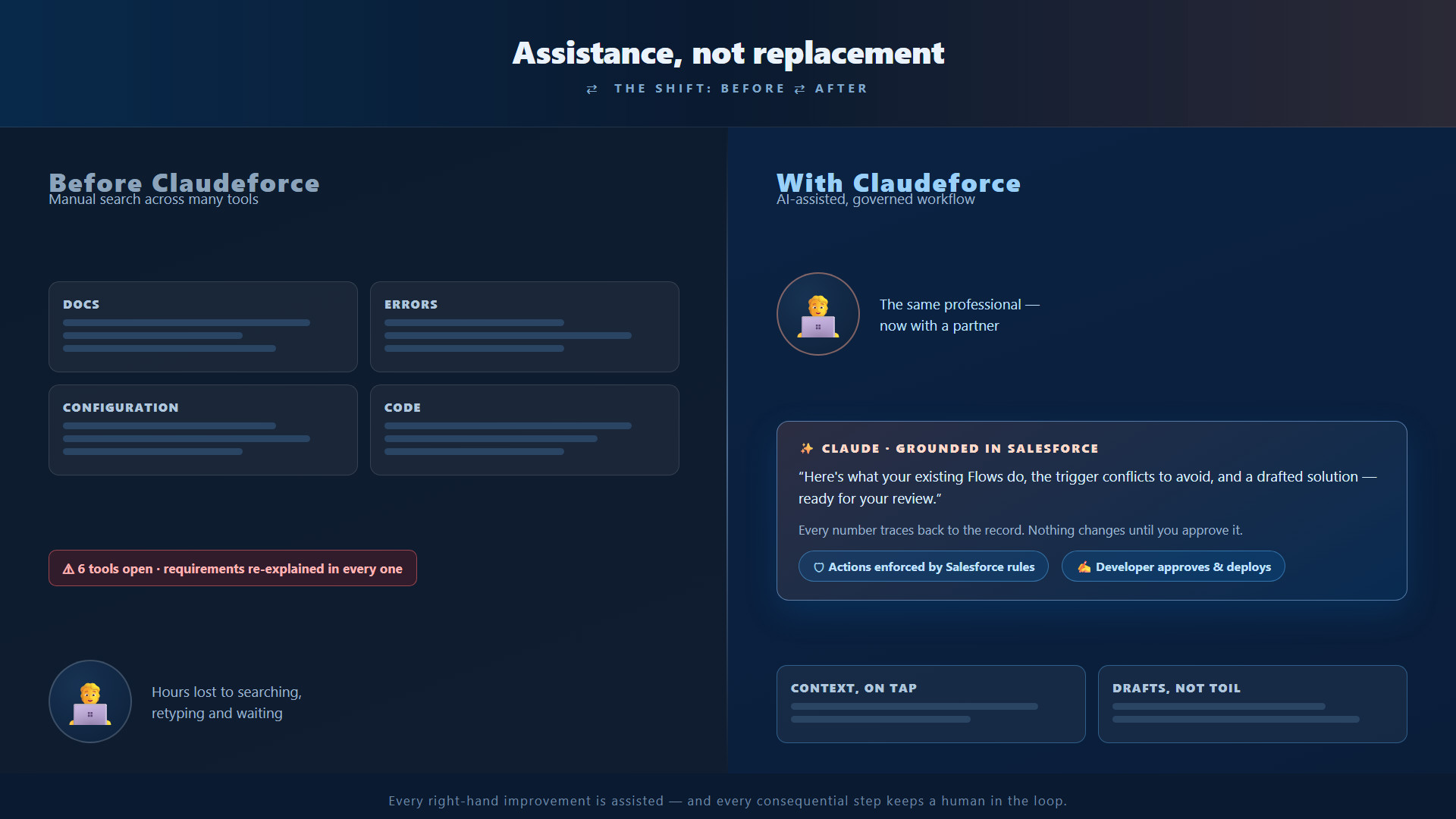
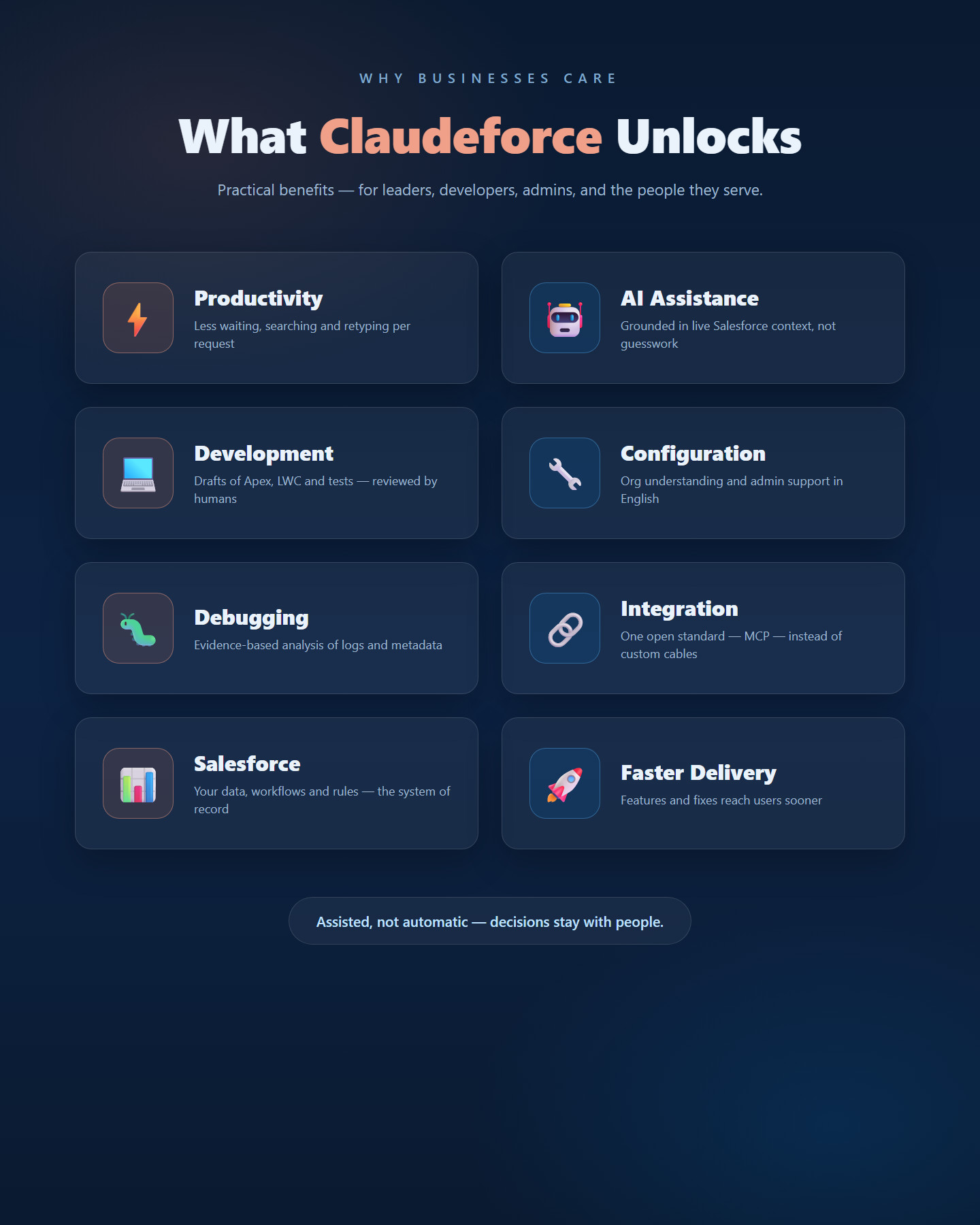
Why Businesses Care About Claudeforce
For business leaders — productivity and velocity. Fewer hand-offs between “what the business asked for” and “what the technical team delivered.” Faster experimentation, because drafting and analyzing no longer cost days. And governed AI adoption: Claudeforce is built to run inside Salesforce’s existing permission model rather than around it — a one-time admin setup with centrally managed auth.
For Salesforce developers — less undifferentiated heavy lifting. Anthropic’s Claude Code is already an agentic coding tool that reads your codebase and edits files, and Salesforce ships official tooling for it: the Salesforce Development Plugin for Claude Code, which auto-detects a Salesforce DX project, plus official Salesforce Skills for generating bulkified Apex, controller logic, and test classes. Salesforce’s own engineering organization uses Claude Code internally. The developer still owns architecture, review, and approval — the AI drafts, explains, and accelerates.
For Salesforce administrators — a way to interrogate the org in English. Via Salesforce’s Hosted MCP Servers (generally available), Claude can securely connect to org logic and data with enterprise-grade authentication — useful for understanding an inherited automation, tracing where a field is used, or drafting Flow designs for review.
For end users — the compounding effect. Features shipped faster, issues diagnosed faster, processes more responsive. When the cost of a “small request” drops, more of those requests actually get done.
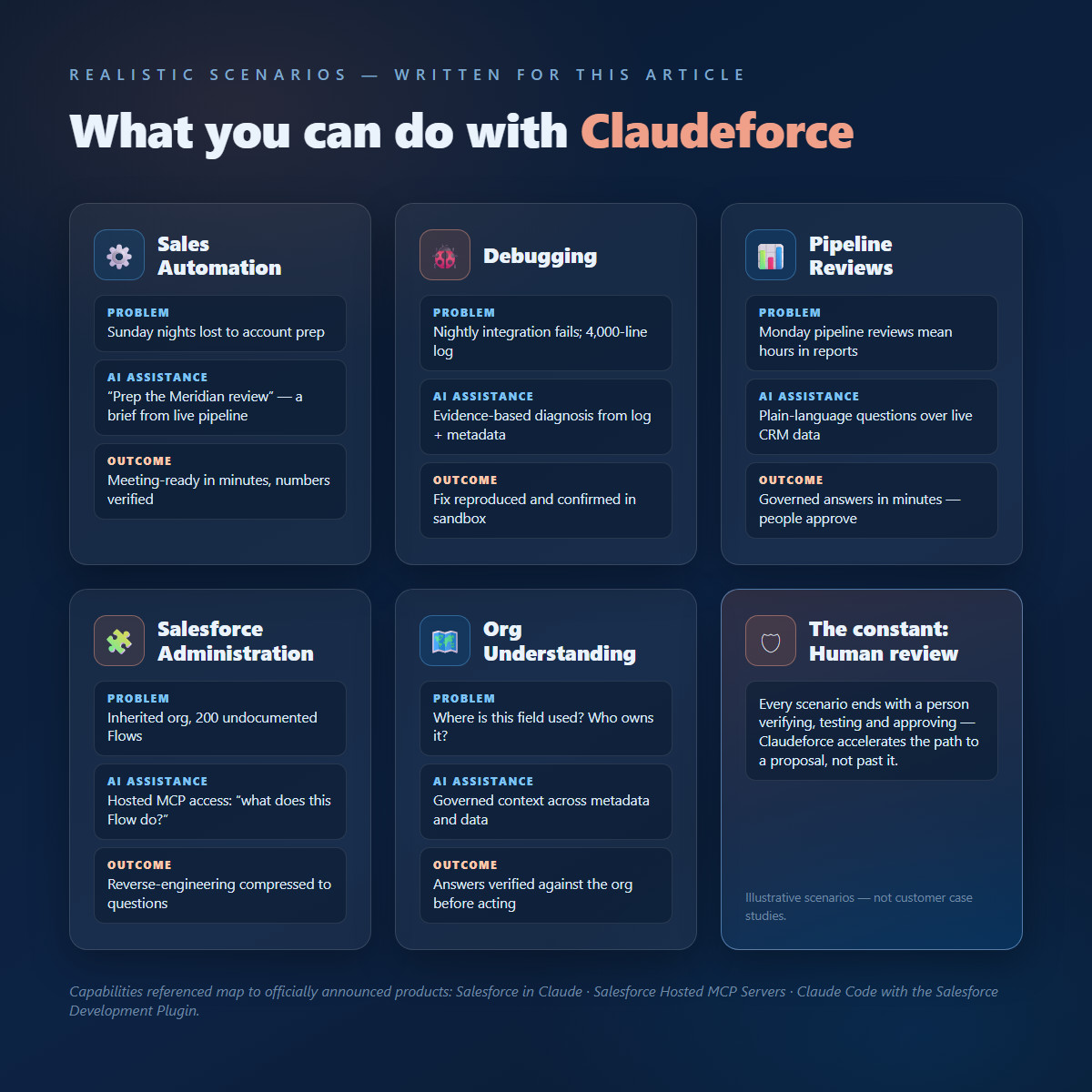
What Can You Actually Do With It? Four Illustrative Scenarios
These are illustrative scenarios written for this article — not customer case studies. Capabilities referenced map to officially announced products.
1. Sales workflow — the flagship
Problem: A rep spends Sunday night prepping Monday’s account reviews across five tabs.
Claudeforce approach: In Claude, using Salesforce in Claude’s sales skills: “Review the Meridian account and prep me for tomorrow.” Claude reasons over live pipeline and activity and returns a meeting brief — the “AI CRO” experience Salesforce and Anthropic demonstrated at launch.
Human review: The rep checks every number against the record before the meeting.
Result: Prep measured in minutes, grounded in governed data.
2. Understanding an inherited org
Problem: A new admin inherits an org with 200 Flows and no documentation.
Claudeforce approach: Using Salesforce Hosted MCP Servers, Claude connects securely to the org; the admin asks what a specific Flow does and where a field is referenced.
Human review: The admin verifies the explanation against Flow Builder before acting on it.
Result: Days of reverse-engineering compressed into guided questions.
3. Apex and LWC development
Problem: A developer needs a trigger handler, tests included, that respects org conventions.
Claudeforce approach: In Claude Code with the official Salesforce Development Plugin and Salesforce Skills, the developer describes the requirement; the plugin detects the DX project and drafts bulkified Apex with test classes.
Human review: Code review, security check, and test inspection — the developer approves and deploys through normal processes.
Result: The skeleton in minutes; the professional judgment stays human.
4. Debugging with context
Problem: A nightly integration fails; the debug log is 4,000 lines.
Claudeforce approach: The developer brings the log and relevant metadata into Claude and asks for a diagnosis with evidence.
Human review: The developer reproduces the issue and confirms the fix in a sandbox.
Result: Faster root-cause hypothesis — validated the traditional way.
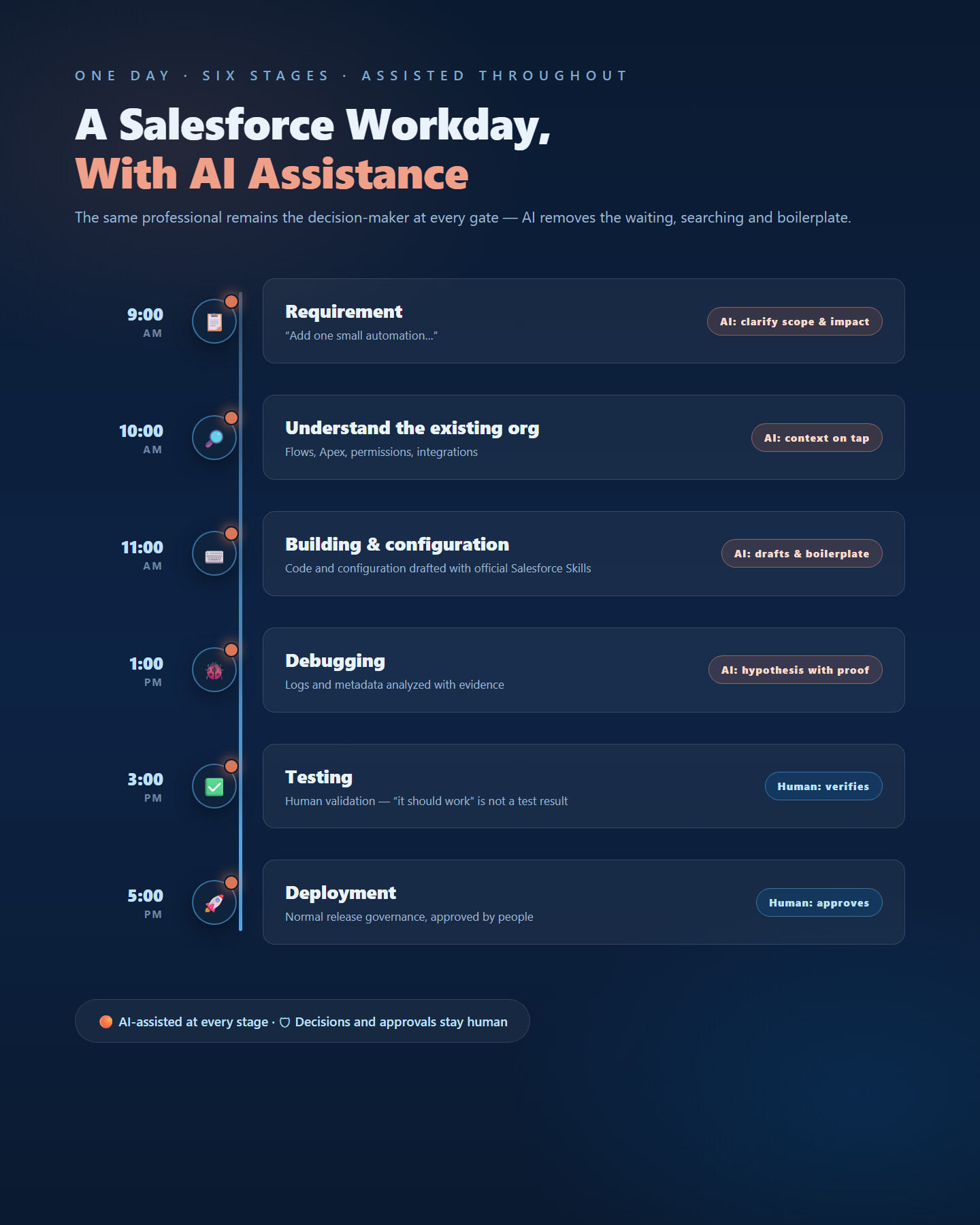
A Salesforce Developer’s Day: Before vs. With AI Assistance
Before: Requirement meeting → hours of research and org archaeology → coding → debugging across logs and Setup → testing → documentation → deployment. The creative work is real, but it’s wrapped in repetitive effort.
With AI assistance: Requirement meeting → plain-language exploration of the org and drafting (AI-assisted) → review and refinement (human) → code and configuration → AI-assisted debugging and test scaffolding → human testing and approval → deployment. The developer remains the decision-maker at every gate; the AI removes waiting, searching, and boilerplate from their day.
Where Does Claudeforce Fit in the Bigger Picture?
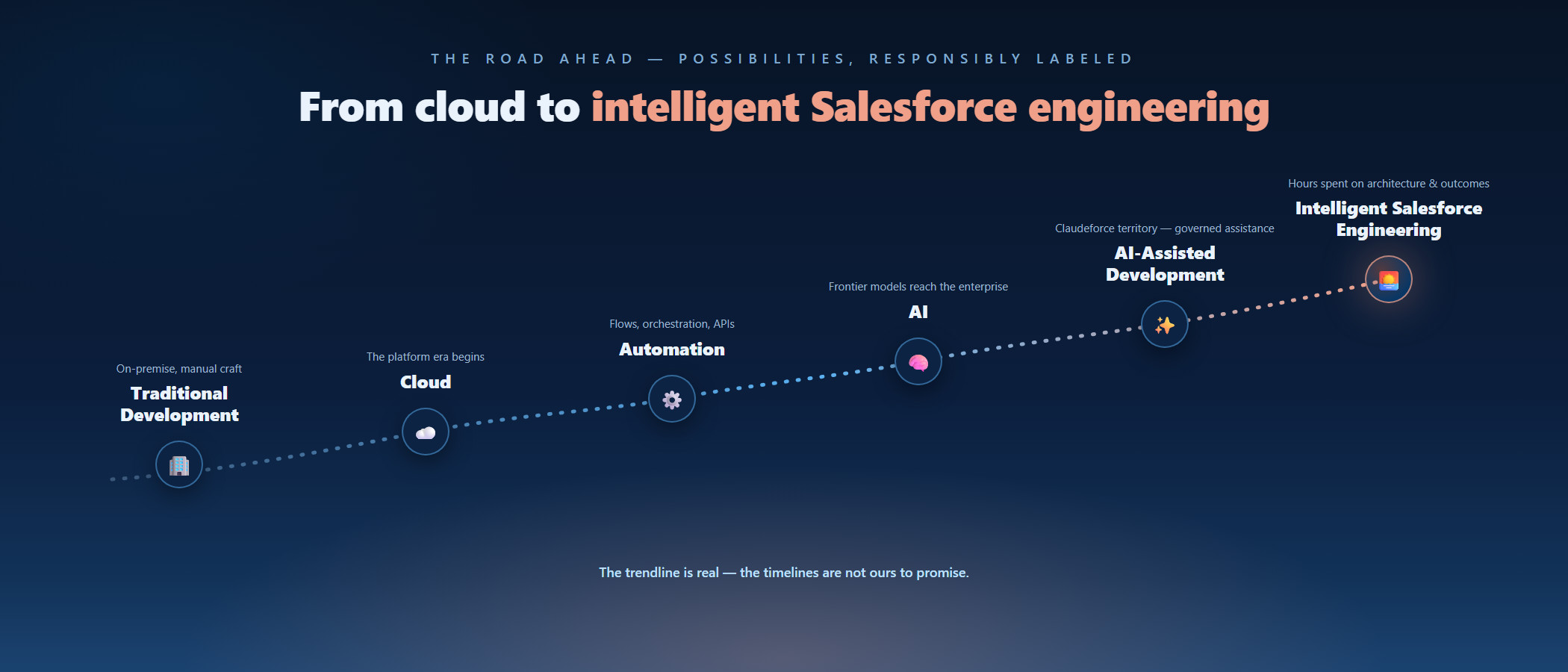
Salesforce work has already passed through two eras: on-premise to cloud, then manual to automated (Flows, orchestrations, integrations). AI-assisted development is the third shift — and it’s happening on standards, not silos. MCP, the open protocol Anthropic introduced in 2024, is now how Salesforce exposes org data and workflows to AI clients; Salesforce hosts and scales those MCP servers the way it hosts its REST APIs.
Claudeforce sits at the convergence: Claude inside Salesforce (as a reasoning model in Agentforce, powering experiences like Agentforce Vibes and Coworker by default), Salesforce inside Claude (the 37-skill plugin), and Claude woven through Slack — where, per the companies’ announcement, Slackbot has delivered 8.1 million annualized productivity hours. Marc Benioff’s framing at launch: “the UI is the AI.” Enterprise software’s next interface may be a conversation you can audit.
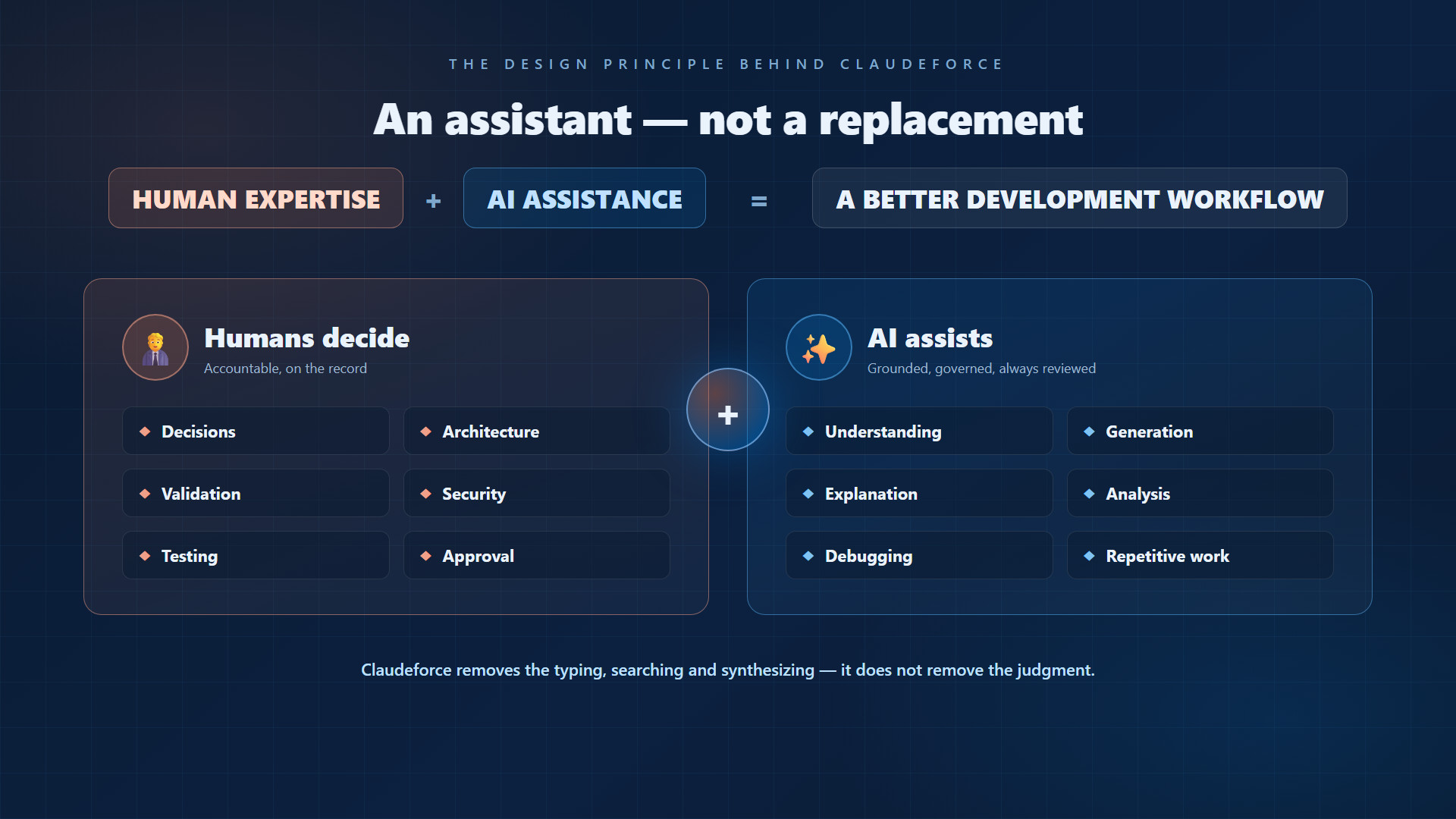
Claudeforce Is an Assistant — Not a Replacement for Human Expertise
The design makes this explicit: actions route through Salesforce’s business rules, permissions stay in force, and Enterprise Frontier Safeguards add zero-retention, customer-controlled keys, and audit logging. But the deeper reason is practical, not technical:
- Humans understand requirements — including the political and historical context no model can infer.
- Humans review code and configuration — an AI draft is a draft.
- Humans own security and architecture — what data may move, and why.
- Humans test — because “it should work” is not a test result.
- Humans approve — business-critical decisions stay with people who are accountable for them.
Claudeforce removes the typing, searching, and synthesizing. It does not remove the judgment. That’s not a limitation to apologize for — it’s the reason enterprises can adopt it.
What Comes Next?
Some of what’s next is already on the official roadmap: Salesforce in Claude moves from pilot to open beta expected in September 2026, more prebuilt skills begin arriving late 2026, and the safeguards rollout continues through fall. The launch page already lists coming-soon coverage for Service, Marketing, Commerce, Revenue, Field Service, Tableau, MuleSoft, Informatica, Data 360, and Industries.
Beyond that, label everything a possibility: natural-language development extending deeper into configuration; intelligent debugging that proposes fixes with evidence; AI-assisted testing and code review; context-aware documentation that writes itself from the org’s actual metadata; and what the industry is starting to call intelligent Salesforce engineering — where professionals spend their hours on architecture, security, and outcomes rather than navigation. The trendline is real; the timelines are not ours to promise.
The Bottom Line
Claudeforce is best understood not as a product you buy but as a shift in where the work happens: from clicking through software to conversing with it, from searching for context to being handed it, from writing every step to working with AI — with Salesforce’s governance and human judgment still firmly in charge.
The future of Salesforce development is not humans versus AI. It is humans working with AI — reviewing, testing, and deciding — at a speed the old workflow never allowed.
Frequently Asked Questions About Claudeforce
What is Claudeforce?
Claudeforce is an expanded strategic partnership between Salesforce and Anthropic, announced August 26, 2026, that puts Salesforce’s trusted data, workflows, and business rules to work inside Anthropic’s Claude. Its first product, Salesforce in Claude, is a plugin with 37 prebuilt skills for sales teams, in pilot with an open beta expected in September 2026.
How does Claudeforce work with Salesforce?
It connects Claude to Salesforce through a secure Model Context Protocol (MCP) connection into Salesforce’s Headless 360 architecture. Actions route through Salesforce, so the permissions and business rules your org already runs on are enforced, and Claude only sees or does what the authorized user can.
Who can use Claudeforce?
Joint Salesforce and Anthropic customers, starting with sales teams via Salesforce in Claude. Setup is a one-time admin task with centrally managed authentication and permissions; Salesforce says broader cloud coverage (Service, Marketing, Commerce, and others) is coming later.
Is Claudeforce only for developers?
No. The first product is built for sellers (meeting prep, deal-health and pipeline reviews). Developers and admins interact with the AI ecosystem through related official tools: Claude Code with Salesforce’s Development Plugin and Skills, and Salesforce Hosted MCP Servers.
Can Salesforce administrators use Claudeforce?
Yes — admins control it. They perform the one-time setup, manage auth and permissions centrally, and can use Salesforce’s Hosted MCP Servers to let Claude securely assist with org understanding and troubleshooting, always within existing permissions.
Can Claudeforce help with Apex?
Not directly through the Claudeforce partnership today — its first skills target sales workflows. For Apex, the official path is Anthropic’s Claude Code plus Salesforce’s own Salesforce Development Plugin and Salesforce Skills, which generate bulkified Apex, controller logic, and test classes for developer review.
Can Claudeforce help with Salesforce Flow?
Claudeforce’s announced skills focus on sales use cases rather than Flow building. Admins can use Claude with Salesforce Hosted MCP Servers to understand and analyze existing automations, and should treat any Flow-design drafting as AI-assisted proposals requiring human review.
Can Claudeforce help debug Salesforce?
AI-assisted analysis can: developers can bring logs and metadata context to Claude and get evidence-based diagnoses. In Claudeforce itself, governed access to live Salesforce data is the foundation; validation and the actual fix remain with the developer.
Does Claudeforce replace Salesforce developers?
No. It’s engineered the opposite way: actions route through Salesforce’s governance, humans review and approve changes, and the announced safeguards (zero data retention, customer-controlled keys, audit logging) exist for accountability. It reduces repetitive effort; it doesn’t remove judgment, architecture, security, or testing responsibilities.
Ready to Explore Claudeforce?
If your team is evaluating Claudeforce or AI-assisted Salesforce development, talk to the Illustre Software Services team to discuss how it could fit your Salesforce org.