How Salesforce is stepping out of the browser tab and into Claude, Slack, Teams and the AI tools your team already uses, without giving up on trust.
Salesforce AIforce is the new “live interface” for Salesforce. It takes your CRM data, workflows and agents and puts them inside Claude, Slack, Microsoft Teams and pretty much any AI your people already work in. I sat through the “AI You Want, Trust You Need” keynote and the Developer Keynote at Dreamforce 2026, and this is my plain-English take on what was announced and why it matters for Salesforce teams.
A Monday morning we all know
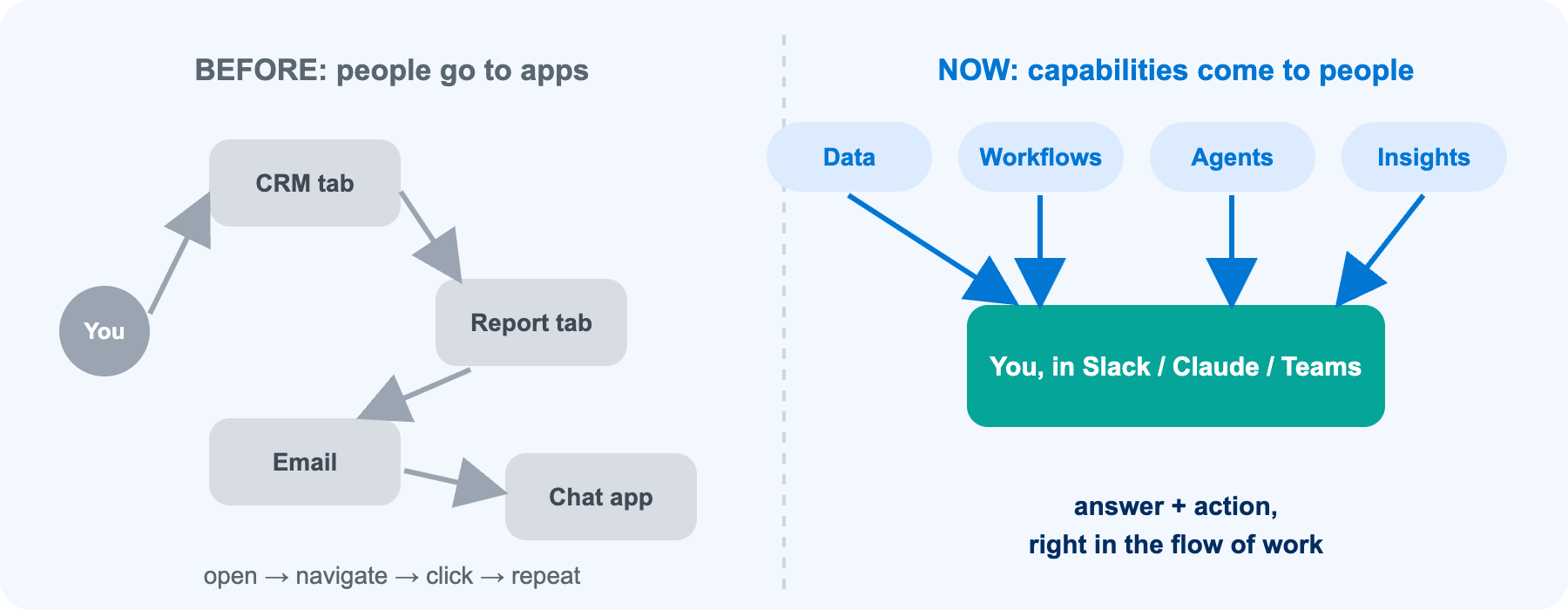
Think about a sales rep starting her week. She opens the CRM, hunts for the right record, jumps into a report, checks her email, scrolls a chat thread, and then goes back to the CRM to fix a field she forgot to update. Five tabs and twenty clicks later, she still hasn’t spoken to a single customer.
That’s how business software has worked for as long as most of us can remember. You go to the app, find the right page, do the task, then move on to the next app. AI turns this around. Instead of people going to the software, the software has to come to the people, into Slack, Teams, Claude or wherever they already spend their day.
That’s really what AIforce is about.
What is Salesforce AIforce?
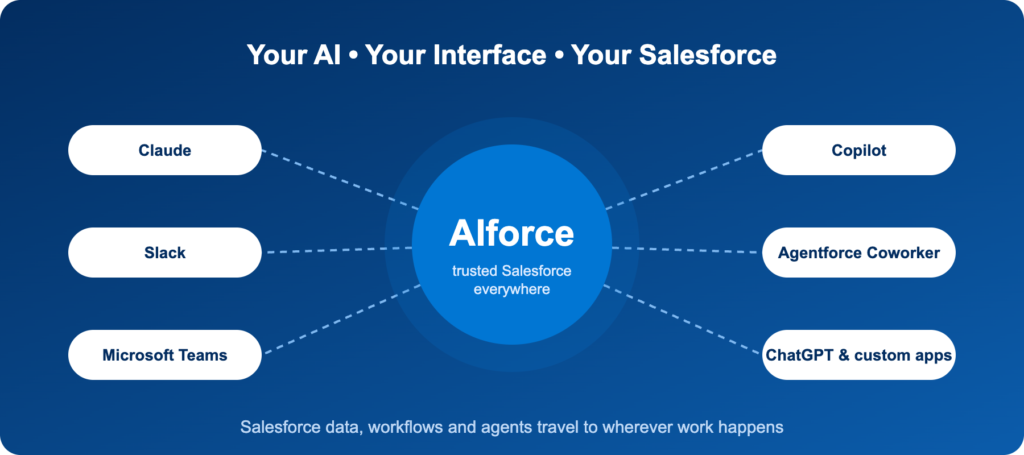
In short, AIforce brings Salesforce to any AI, any interface and any agent. Salesforce’s own tagline is “Your AI, your interface, your Salesforce.”
The last part is the one that matters. AIforce doesn’t give an AI a thin copy of your data. It brings the whole platform with it:
- Data 360: your data and metadata foundation.
- Customer 360: your business context, meaning what an “opportunity” or a “VIP” actually means in your company.
- Agentforce: your digital workforce of agents.
- Trust and governance: identity, permissions and access rules that go wherever the data goes.
Salesforce describes it as resting on four pillars: data and context in every interaction, actions and workflows that run your business logic anywhere, identity and permissions that follow users around, and governance that reaches beyond the Salesforce platform itself.
You get it as four ready-made experiences:
- Claudeforce: Salesforce inside Claude through a prebuilt MCP server, with 37 sales skills ready to go (prospecting, pipeline management and so on). It’s in beta for all customers since Dreamforce 2026. I’ve written a separate guide on what Claudeforce is if you want the details.
- Slackforce: turns Slack into a shared Salesforce workspace, where a team can work on the same live records right inside a conversation.
- Agentforce Coworker: an AI teammate inside Salesforce that looks at accounts, activity and history, and always stays within your existing permissions and business rules.
- Headless Toolkit: MCPs, APIs and skills that let developers plug Salesforce into any AI, agent or app. More surfaces, like Microsoft Teams, are on the way.
Why AIforce? Because the model on its own isn’t enough
Two things changed at the same time.
- Users moved. People still log in to Salesforce, but they also live in Slack, Teams, Claude and other assistants. More and more, the “user” isn’t even a person. It’s an agent.
- Agents need a different way in. An agent doesn’t need a screen. It needs what’s behind the screen: your APIs, metadata, business meaning, permissions and governance.
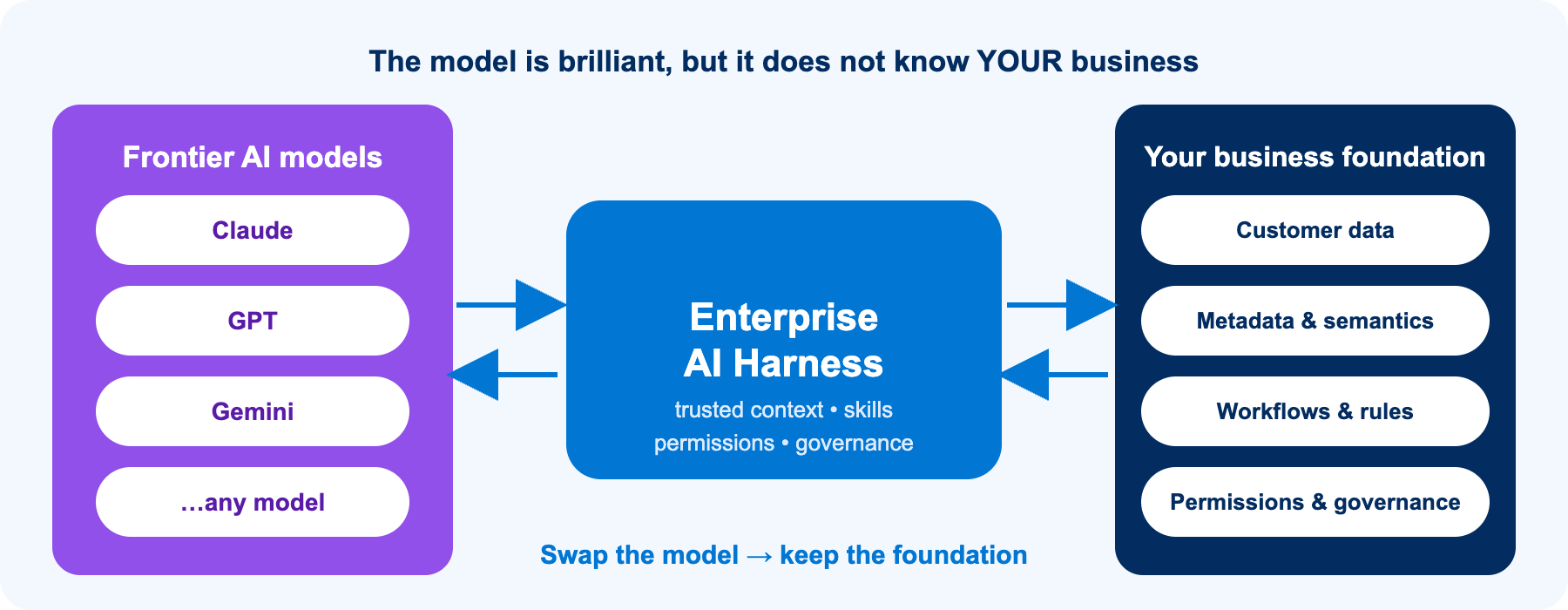
Today’s AI models are great at reasoning, writing and summarising. But ask one to send the right field technician to a job, or update an opportunity without breaking your business rules, and it gets stuck. It simply doesn’t know your business. And no company can afford to wait while a model slowly figures that out.
Salesforce’s answer is what it calls the Enterprise AI Harness. You have AI models on one side, your business foundation on the other, and a trusted layer in between that gives any model governed access to everything you’ve built. The part I like most: you can swap models later without rebuilding anything.
How AIforce works: the Headless Toolkit under the hood
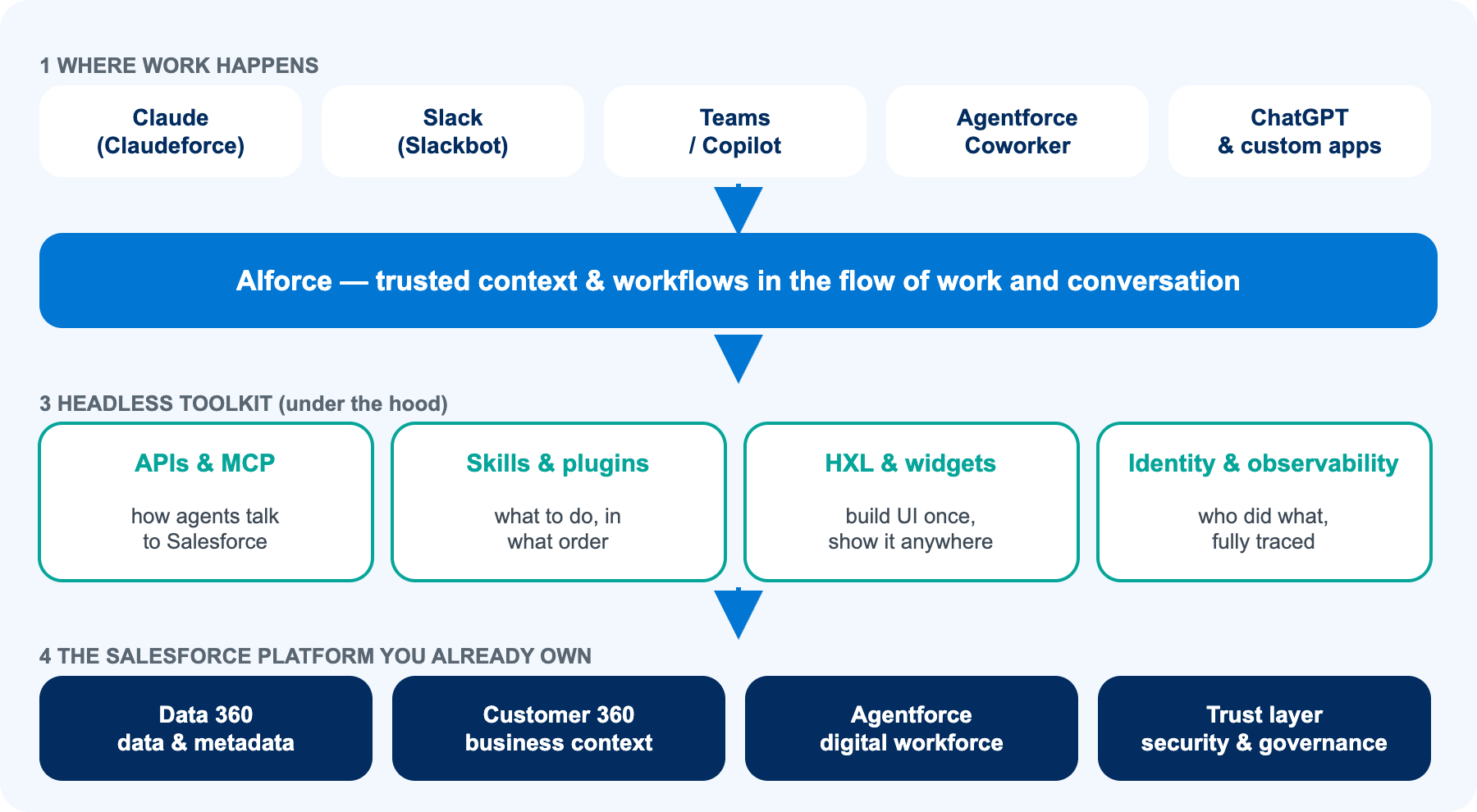
If AIforce is what you see, the Headless Toolkit is the engine. “Headless” just means Salesforce’s features are no longer tied to Salesforce’s own screens. Salesforce puts it as “the API is the UI.” The toolkit gives agents four things:
- APIs and MCP: how agents talk to Salesforce. The Salesforce MCP server is the front door for outside agents like Claude.
- Skills and plugins: the playbook, meaning which steps to take and in what order. Hundreds of agent skills now sit in one GitHub repository so agents can find and use them.
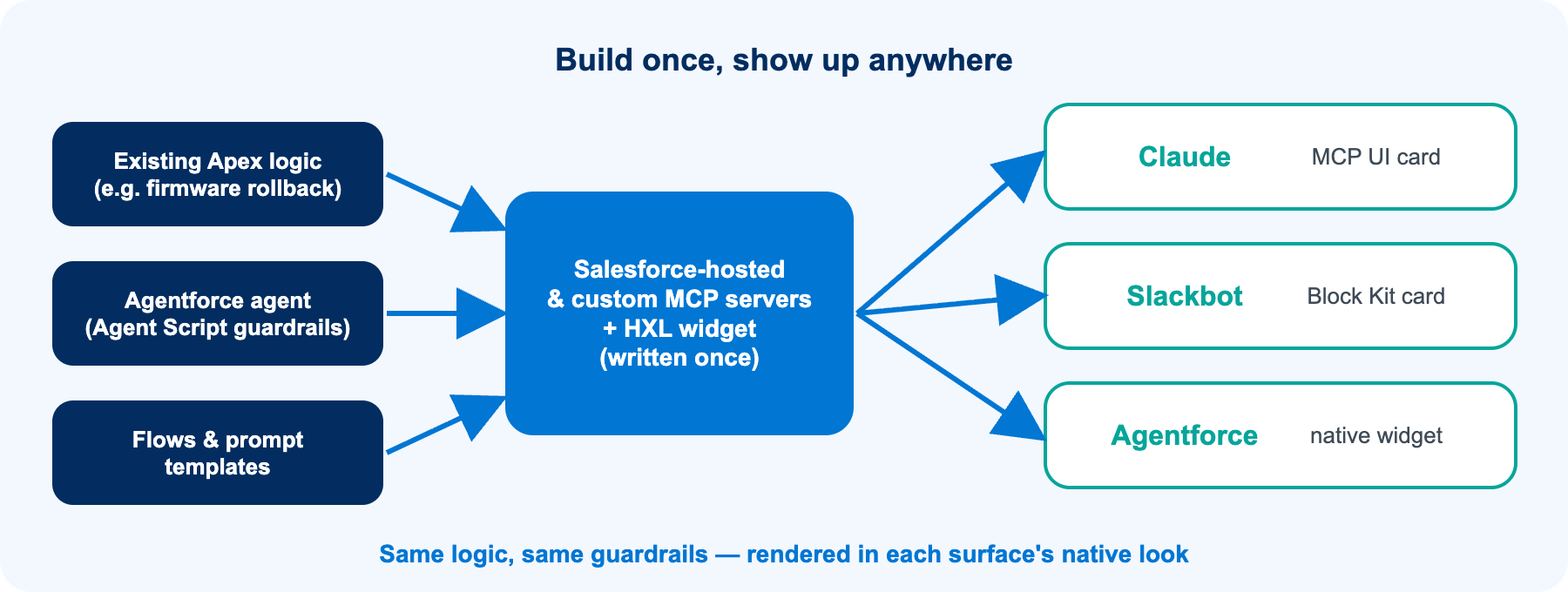
- Headless Experience Layer (HXL) and widgets: build a UI card once and show it in Agentforce, Slack, ChatGPT or Claude with the same look. (More on this in my HXL guide.)
- Identity and observability: so admins can see and understand everything agents do.
And here’s the bit most customers will care about. Everything you’ve built over the years, like custom objects and fields, Apex, Flows, sharing rules and user identity, is available to agents straight away. You don’t have to re-architect anything.
AIforce in action: a day at Stellar Fest
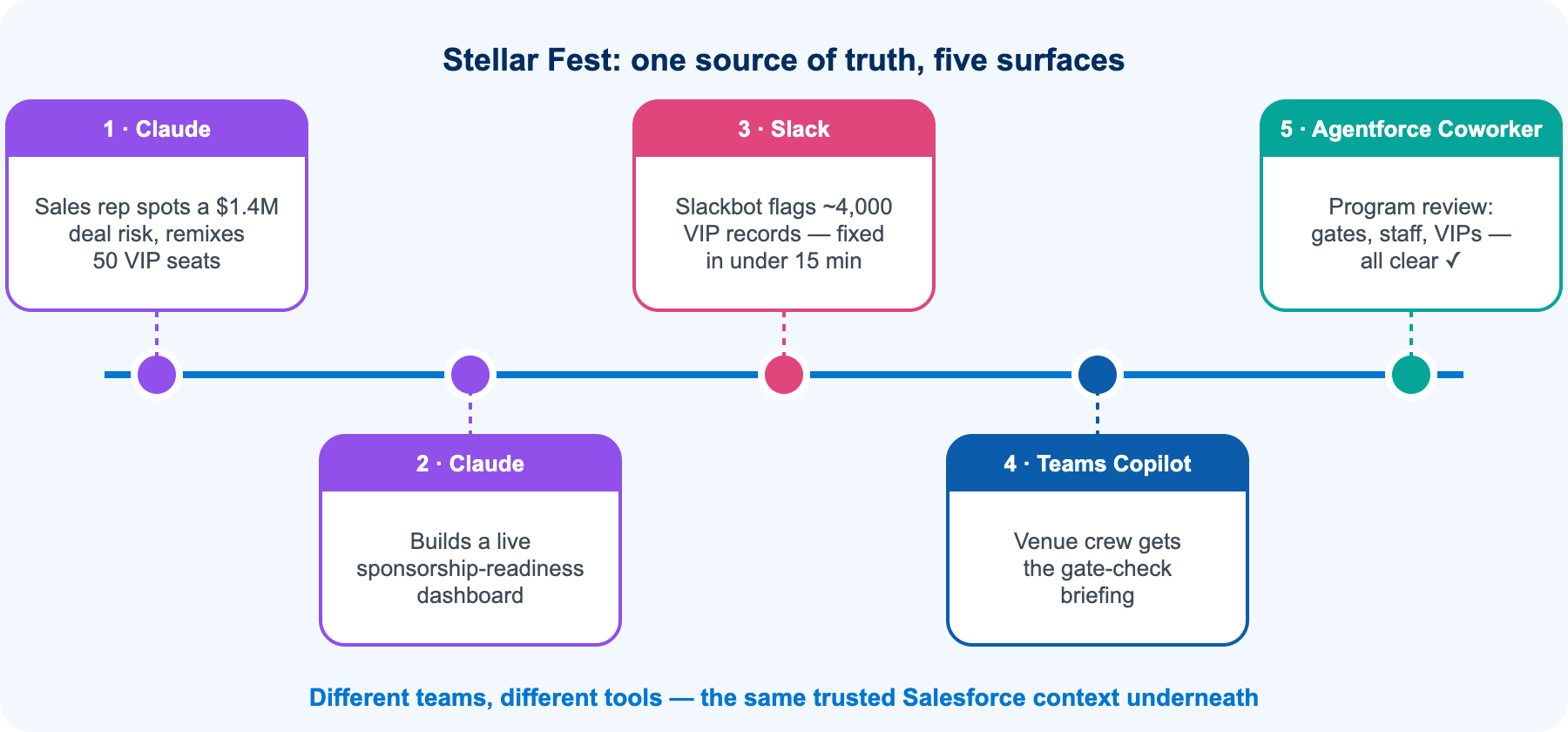
To make it concrete, the keynote followed Stellar Media, a made-up events company a few hours away from its big music festival. Every team uses a different tool, but they all work from the same Salesforce data.
Morning, in Claude. A sponsorship rep asks Claude if anything could put her $1.4M Helio Mobile deal at risk. Claude pulls from the Salesforce MCP server and sales skills, along with email, calendar, call notes and Slack. The answer: 50 of the 200 promised VIPs don’t have seats. Claude suggests moving them to the Skyline Terrace, writes the change back to Salesforce in one click, and drafts the email to the customer.
Then she builds something. She asks Claude for a sponsorship-readiness dashboard across all her accounts and gets a live view built on Salesforce data. No hours spent in the report builder.
Festival day, in Slack. A readiness check from Slackbot finds about 4,000 VIP records that broke overnight. That’s roughly 500 guests who would have been turned away at the gate. The ticketing team picks it up in Slack, sees what went wrong and reactivates the records. Fixed in under 15 minutes.
At the venue, in Teams Copilot. The crew lead asks what gate staff need to know and gets a short briefing: don’t turn away any Helio Mobile VIPs, and send any problems to ticketing.
Final check, in Agentforce Coworker. The program lead asks for a review. Gates, staffing, sponsor activation and VIP access all look good.
Building on Salesforce, whatever your skill level
AIforce isn’t just about using Salesforce from other tools. It changes how you build on it too. The idea: work where you like, build once, deploy anywhere, and let more people build.
- Salesforce development in Claude: a developer plugin that understands your org’s metadata and how to deploy. You describe what you want in a plain-English markdown file, Claude looks at the org, suggests what to reuse or extend, then builds objects, fields and a React app (Salesforce now supports several frameworks) and runs the tests.
- Headless Experience Layer (HXL): templates and a playground for designing widget cards that look the same in Agentforce, Slack, ChatGPT and Claude.
- Builder Central: a new low-code admin experience you drive with plain language. A product manager can paste in a requirements doc, get objects and a concierge agent generated, ask it to re-brand from the CMS, and ship to web and mobile.
AIforce for developers: how, what and where we build
The Developer Keynote told the same story from a builder’s point of view. This time the made-up company was Radiant Homes, whose firmware update had knocked smart-home devices offline. The message was that AI is changing how we build, what we build and where software shows up, and AIforce is the “where”.
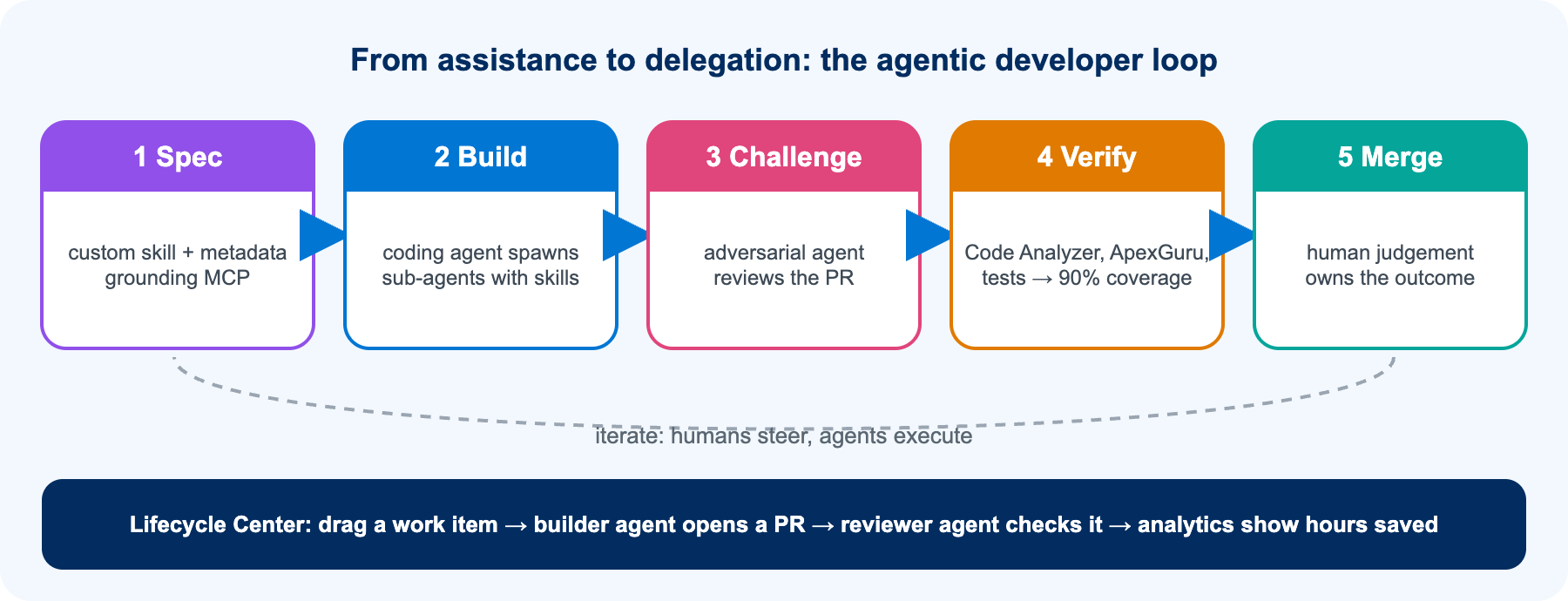
How we build: from getting help to handing off work. A year ago we asked AI to write a class. Now developers give a coding agent a goal and let it run for hours. With the Salesforce development plugin for Claude Code, now generally available (other coding agents are supported through the Headless Toolkit), a developer writes a spec using a custom skill that knows the org’s metadata. The agent reuses what’s already there, such as a Data 360 calculated insight, existing objects or a trigger framework, and builds with sub-agents. Another agent reviews the pull request, and Code Analyzer, ApexGuru and Apex tests keep running until coverage hits 90%. The developer’s job gets bigger, not smaller: set the goal, design the architecture, connect the context and keep things governed.
For smaller backlog items, Lifecycle Center adds built-in architecture, build and review agents. Drag a bug to “ready” and a builder agent clones the repo and opens a PR, then a reviewer agent checks it. A workbench shows each agent’s logs, lets you switch models if one goes off track, and tracks lines accepted and hours saved.
What we build: software that thinks and acts. Agentforce agents run on Agent Script, which mixes plain-language instructions with fixed rules, for example only refunding customers who meet a certain threshold. Agentforce Vibes (the free tier is back) adds real-time Data 360 context and tests agents against lots of different prompts, while Testing Center and agent analytics log every reasoning step so you can keep improving.
Where it shows up: this is AIforce for developers. Salesforce-hosted MCP servers can expose Agentforce agents, Apex actions, flows and prompt templates as tools for any agent. Radiant exposed its existing Apex rollback class through a custom MCP server, so an operations manager could just say “roll back those cameras” in Claude, and Radiant’s own rule of fixing safety-critical devices first still applied. HXL (in beta) then swapped a wall of text for an interactive card. You define the widget once in metadata, and HXL shows it as MCP UI in Claude, Block Kit in Slack and a native widget in Agentforce. For classic screens, apps can now run React and Angular natively, including Angular micro-frontends inside Lightning pages, and GraphQL mutations for writes are generally available.
Trust and security: the guardrails that keep AI agents safe
More builders and more agents only work if trust keeps up. Two announcements deal with this.
Agentic identity. Every agent gets its own proper identity on the platform, so what it does can be governed and traced, just like a person.
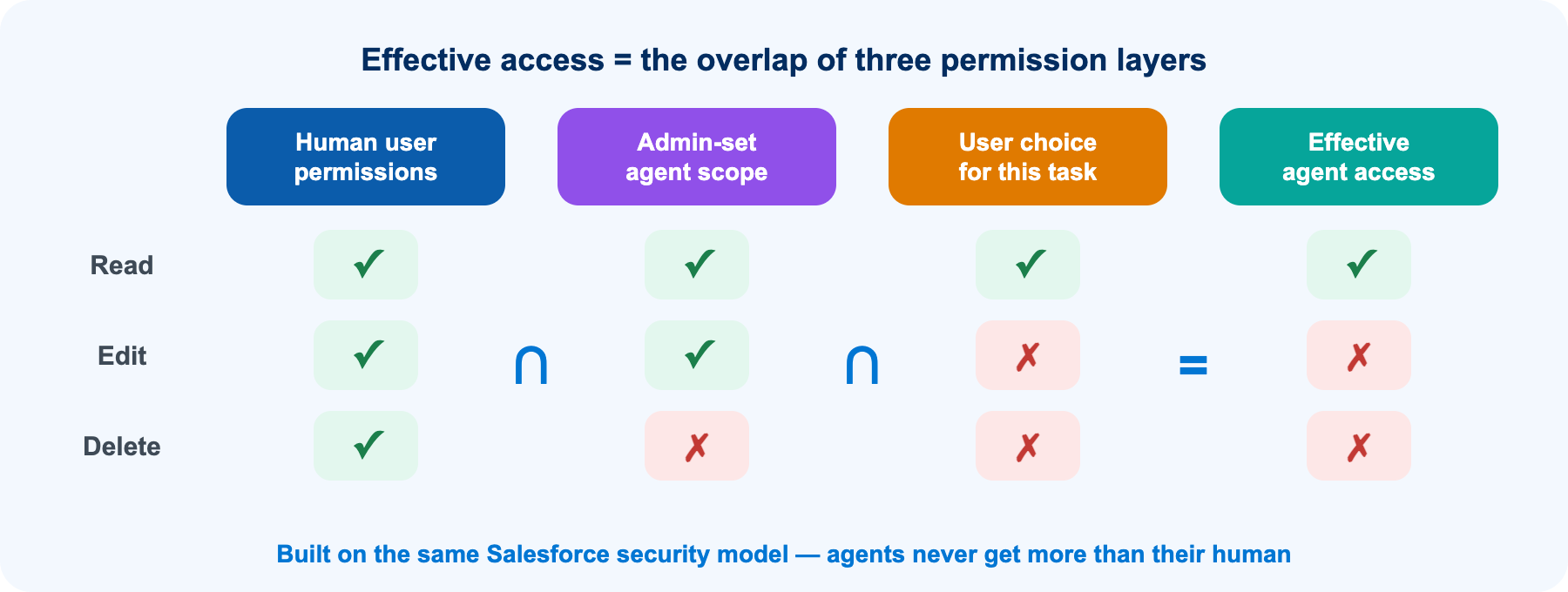
Scoped access controls. What an agent can actually do is the overlap of three things: what the user can do, what the admin allows agents to do, and what the user allows for this particular task. Say a user can delete opportunities, the admin only lets agents read and edit, and the user picks read-only for today. The agent can only read. It all runs on the same security model Salesforce customers have trusted for 20 years.
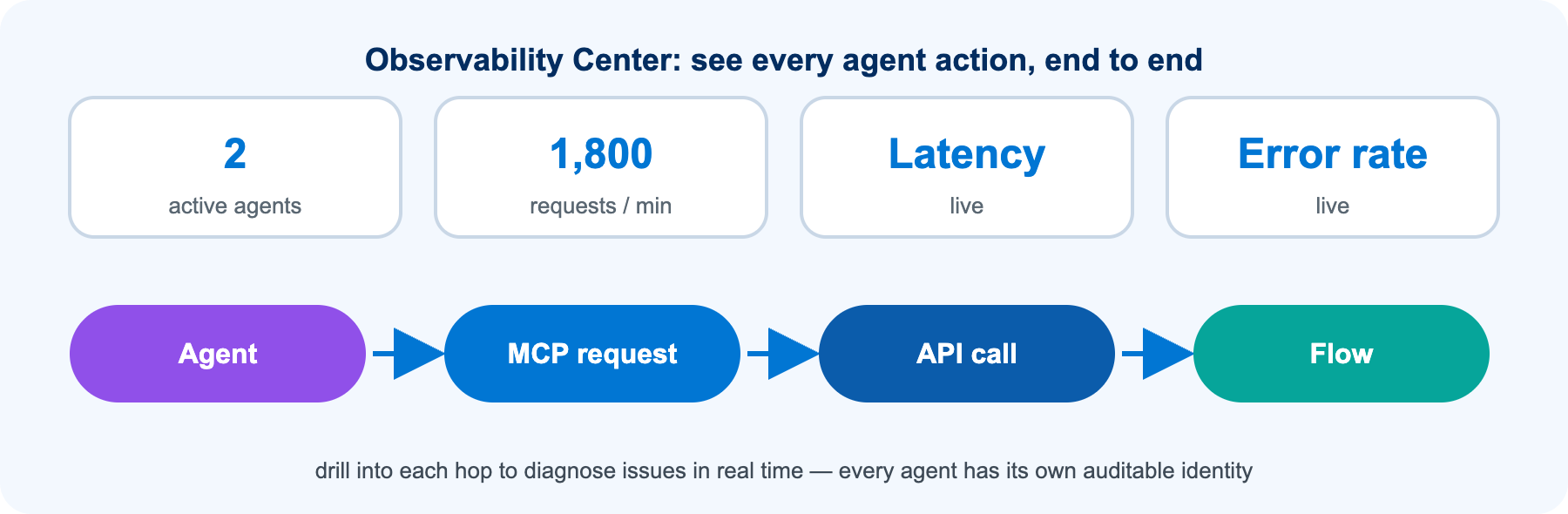
Observability Center. A single view of agent activity, including active agents, requests per minute, response times and error rates. You also get a full trace of each call (for example MCP request, then API call, then Flow) that you can dig into when something goes wrong.
The payoff: real-world ROI from AIforce
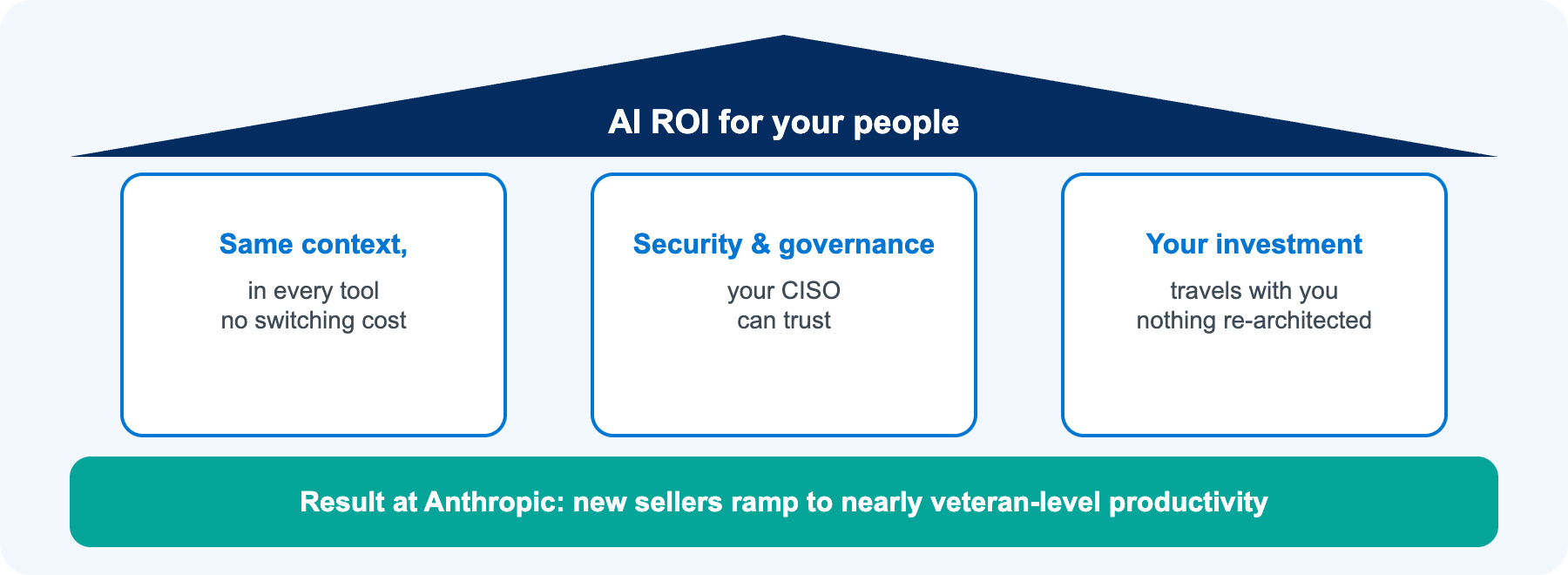
After thousands of conversations with customers, Salesforce boiled AI ROI down to three things: the same context in every tool, security and governance your CISO is happy with, and your existing Salesforce investment coming along with you.
Anthropic runs its own sales and go-to-market on Salesforce and was one of the first to build Salesforce-in-Claude workflows. Its sellers now mostly talk to Claude instead of clicking through screens. Claude keeps Salesforce up to date from call transcripts, emails and Slack, and teams build pipeline reviews, forecasts and decks on top of that data. The result Anthropic shared surprised me: new sellers are almost as productive as experienced ones, because the know-how is built into skills and workflows.
Deloitte, a Salesforce partner for 20 years whose front office runs on Sales Cloud, Agentforce and Informatica, saw AIforce as a way to push its headless strategy forward without starting over, keeping its data, permissions and governance. Early feedback has been very positive: fewer tabs, less chasing, and more time with clients.
Quick reference: who connects to what
| Piece | What it does | Where you see it |
|---|---|---|
| AIforce | Brings Salesforce data, workflows and agents to any AI or interface | Claude, Slack, Teams, Copilot, Agentforce Coworker, custom apps |
| Enterprise AI Harness | Gives AI models trusted access to your business foundation | Behind every AI answer |
| Headless Toolkit | APIs, MCP, skills, HXL, identity and observability | Developers and architects |
| Salesforce MCP server | Front door for outside agents | Claude and other MCP clients |
| HXL | Build UI widgets once, show them anywhere | Agent chats, web and mobile |
| Builder Central | Low-code building and admin in plain language | Admins, PMs, citizen builders |
| Agentic identity + scoped access | Gives each agent its own identity and only the access it needs | Security and admin teams |
| Observability Center | Traces and monitors every agent action | Admins and operations |
Back to Monday morning
Let’s go back to our sales rep. With AIforce, she doesn’t open five tabs. She asks one question in the tool she already has open, gets an answer based on her company’s real data, and acts on it in one click. Meanwhile, her admin can see exactly what the agent did and why it was allowed to.
Salesforce is also bringing AIforce to AgentExchange, so partners can take it to even more places. But the core idea is simple. AI with trusted context is powerful, and it’s at its best when it frees people up to bring judgement, care and ideas to their work.
The AI you want, with the trust you need.
Salesforce AIforce FAQs
What is Salesforce AIforce?
AIforce is Salesforce’s live interface for AI. It brings Salesforce data, workflows, agents and security into tools like Claude, Slack, Microsoft Teams and custom apps, so people can work with Salesforce without opening the Salesforce app.
What is Claudeforce?
Claudeforce is Salesforce inside Claude. It uses a prebuilt Salesforce MCP server and comes with 37 ready-made sales skills such as prospecting and pipeline management.
Is AIforce available now?
Parts of it are. Claudeforce went into beta for all customers at Dreamforce 2026, and the Salesforce development plugin for Claude Code is generally available. Other pieces, like HXL, are in beta, and more surfaces such as Microsoft Teams are being added over time.
How is AIforce different from Agentforce?
Agentforce is Salesforce’s platform for building and running AI agents. AIforce is the layer that takes Salesforce, including those Agentforce agents, out to any AI tool or interface your team uses.
Is my data safe when AI agents use Salesforce through AIforce?
AIforce runs on Salesforce’s existing security model. Each agent gets its own identity, its access is limited by user, admin and task-level permissions, and Observability Center lets admins trace every action.
Need help getting your Salesforce org ready for AIforce, Claudeforce or Agentforce? Talk to the Illustre team.